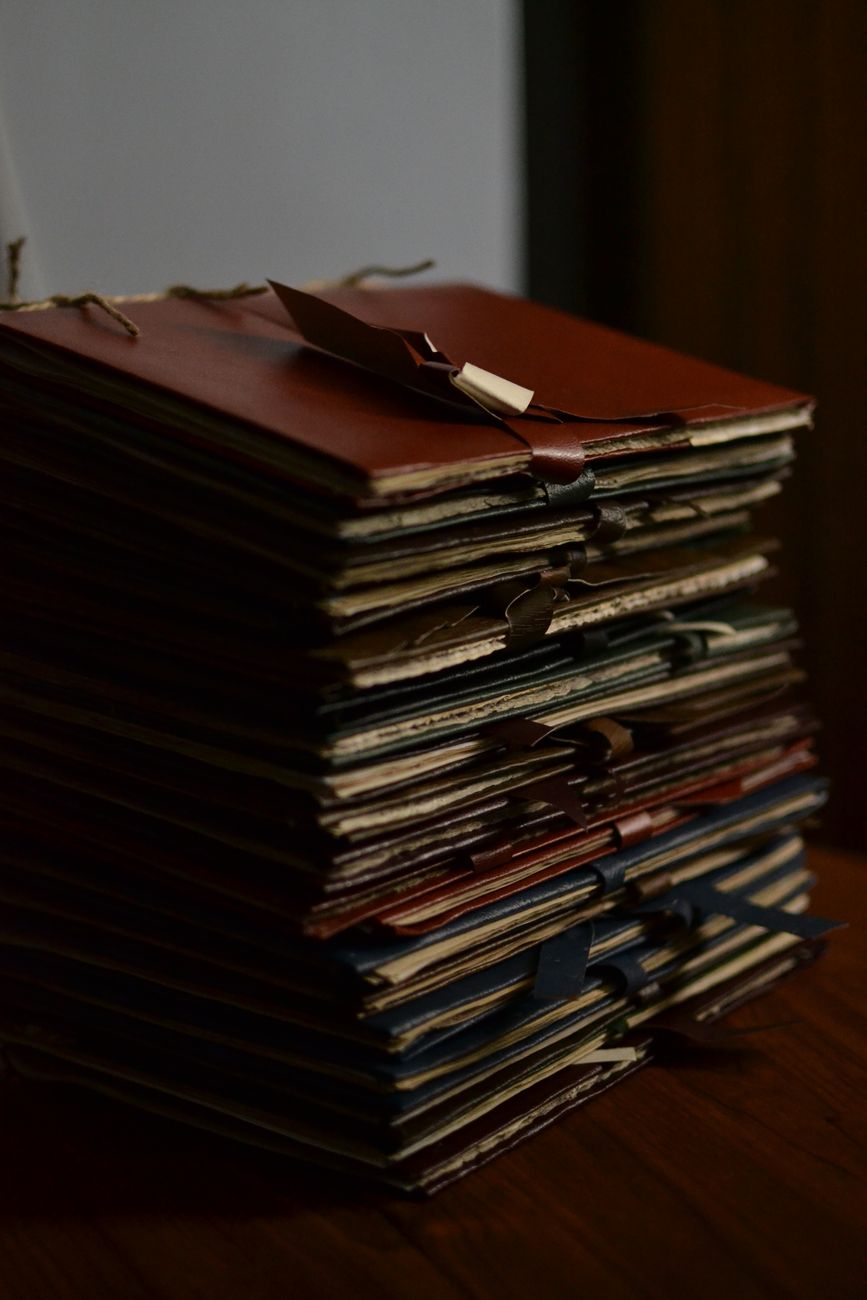
Bookbinding is the craft of joining pages together to make a book, notebook, journal, sketchbook, or handmade booklet. It can be done with thread, glue, staples, rings, covers, or folded paper, depending on what type of book you’re making.
It’s a useful craft for beginners because you can start with simple folded booklets and gradually learn more detailed binding methods. You don’t need to attempt a professional-looking hardback book straight away.
How Does Bookbinding Work?
Bookbinding works by gathering pages together and attaching them so they can be opened, turned, and used like a book.
The pages may be folded into groups, sewn together, glued along one edge, or attached inside a cover. Some bindings are very simple, while others are more detailed and need careful measuring, cutting, folding, and stitching.
For instance, a simple booklet might be made by folding several sheets of paper in half and stitching them through the fold. A more advanced handmade journal might have multiple folded sections sewn together with a strong cover.
What Can You Make With Bookbinding?
Bookbinding can be used to make many different projects, including:
- Notebooks
- Journals
- Sketchbooks
- Handmade books
- Zines
- Mini books
- Scrapbooks
- Photo books
- Travel journals
- Art journals
- Recipe books
- Poetry books
- Planners
- Memory books
- Small gift books
Beginners often start with simple pamphlet-style booklets, mini notebooks, or folded paper books because these are easier to make than large, hardback books.
Is Bookbinding Good for Beginners?
Yes, bookbinding can be good for beginners. Some forms of bookbinding are very simple and only need paper, a needle, thread, and basic measuring tools.
The main challenge that you may encounter is accuracy. Bookbinding often looks better when the pages are folded neatly, the holes are lined up, and the cover is cut to the right size. Keep in mind, however, that beginner books really don’t need to be perfect.
It’s best to get started with a small project; a simple handmade notebook is much easier than a thick journal with a hard cover.
What Do You Need to Start Bookbinding?
To start simple bookbinding, you may need:
- Paper
- Card for the cover
- A ruler
- A pencil
- Scissors or a craft knife
- A cutting mat
- A bone folder or similar folding tool
- A needle
- thread
- An awl or sharp tool for making holes
- Clips or clamps
You don’t need lots of specialist tools at the beginning. For a very simple booklet, paper, card, thread, a needle, and something to make holes may be enough to get you going.
If you enjoy the craft, tools like a bone folder, awl, cutting mat, and craft knife can make the process neater and easier.
What Is a Bone Folder?
A bone folder is a tool used to crease, fold, and smooth paper. It helps create sharper folds than just using your fingers.
Despite the name, many modern bone folders are made from plastic, Teflon-style material, or other smooth materials rather than actual bone.
A bone folder is useful in bookbinding because clean folds help the pages sit neatly together. It is not essential for a first-time experiment, but it is a helpful tool if you want neater handmade books.
What Types of Bookbinding Are There?
There are many types of bookbinding, but beginners only need to know a few at first.
Common bookbinding methods include:
- Pamphlet stitch: a simple sewn binding through the fold of the pages.
- Saddle stitch: folded pages attached through the centre, often with staples or thread.
- Japanese stab binding: pages are stacked and stitched through holes near one edge.
- Perfect binding: pages are glued along the spine, often used for paperbacks.
- Coptic binding: a decorative exposed stitch binding that allows books to open flat.
- Case binding: a traditional hardback bookbinding method.
For beginners, pamphlet stitch and Japanese stab binding are usually the easiest places to start.
What Is the Easiest Type of Bookbinding?
One of the easiest types of bookbinding is pamphlet stitch. This method uses folded sheets of paper and a simple line of stitching through the centre fold.
A basic pamphlet stitch booklet can be used as:
- A mini notebook
- A zine
- A sketchbook
- A small journal
- A handmade gift
- A simple poetry booklet
It is a good beginner project because it teaches folding, hole-making, stitching, and cover placement without being too complicated.
Is Bookbinding Expensive?
Bookbinding does not have to be expensive. You can start with paper, card, thread, and basic tools you may already have lying around the house.
Where it can become more expensive is if you buy specialist paper, book cloth, binding boards, decorative covers, professional tools, presses, adhesives, or large paper cutters. However, beginners do not need all of these.
A sensible beginner setup is:
- Paper
- Card
- Ruler
- Pencil
- Needle and thread
- Awl or hole-making tool
- Clips
- Scissors or a craft knife
That is enough to try a simple handmade booklet.
Is Bookbinding Messy?
Bookbinding is usually low mess, especially if you start with simple stitched bindings. It mainly involves paper, folding, cutting, measuring, and sewing.
It can become messier if you use glue, paint, ink, or decorative covers. Glue-based binding may need more drying time and a protected work surface.
For small-space crafting, simple sewn booklets are a good option because the supplies are compact and easy to pack away.
What Paper Is Best for Beginner Bookbinding?
For beginner bookbinding, ordinary printer paper can be used for practice. It is affordable and easy to fold. However, you may want slightly better paper for sketchbooks, journals, or finished gifts.
Good beginner paper options include:
- Printer paper for practice
- Drawing paper for sketchbooks
- Cartridge paper for art books
- Lined paper for notebooks
- Coloured paper for decorative books
- Scrapbook paper for covers or inserts
The best paper depends on how the finished book will be used. A sketchbook needs paper that can handle drawing materials, while a notebook only needs paper that feels comfortable to write on.
What Can You Use for Book Covers?
Book covers can be made from many materials, including:
- Card
- Scrapbook paper
- Kraft card
- Thick paper
- Fabric-covered card
- Recycled packaging
- Decorative paper
- Thin cardboard
- Book board
For beginners, card is usually easiest to use, as it’s simple to cut, fold, and stitch. Very thick board can be saved for later, when you are more confident with measuring and construction.
Is Bookbinding the Same as Making a Journal?
Bookbinding and journal making overlap, but they are not exactly the same.
Bookbinding is the method of making the book structure. Journal making may include bookbinding, but it can also involve decorating, writing, planning, scrapbooking, or art journaling.
For example, if you sew pages into a cover, that is bookbinding. If you then decorate and use the book as a personal journal, that then becomes journal making.
Bookbinding can be useful for junk journaling, sketchbooking, scrapbooking, and handmade stationery.
Common Beginner Bookbinding Mistakes
Common beginner bookbinding mistakes include:
- Cutting pages unevenly
- Folding paper roughly
- Making holes in the wrong place
- Using thread that is too weak
- Pulling stitches too tightly
- Choosing too many pages for a first project
- Using paper that is too thick to fold neatly
- Rushing the measuring stage
A useful beginner tip is to start with fewer pages than you think you should. A small booklet is easier to fold, align, and stitch than a thick journal.
What Is the Easiest Bookbinding Project?
One of the easiest bookbinding projects is a small pamphlet stitch notebook.
Other easy beginner projects include:
- A mini notebook
- A folded zine
- A simple sketchbook
- A small journal
- A handmade gift booklet
- A poetry booklet
- A travel notes booklet
- A simple scrapbook insert
It is best to start with a project that has only a few sheets of paper and one simple cover. This helps you to learn the basic process without needing to use too many materials.
Who Might Enjoy Bookbinding?
Bookbinding may suit you if you like paper crafts, stationery, journaling, sketchbooks, writing, or handmade gifts.
It may also be a good hobby if you want something:
- Practical
- Creative
- Low mess
- Suitable for small spaces
- Good for handmade gifts
- Linked to journaling and paper crafts
- Possible to start cheaply
However, bookbinding may feel frustrating if you dislike careful measuring, folding, and cutting. This craft rewards patience and neatness, especially as projects become more advanced.
Final Thoughts
Bookbinding is the craft of joining pages together to make books, notebooks, journals, sketchbooks, and handmade booklets. It can be simple or advanced, depending on the binding method and materials you choose.
If you are new to bookbinding, start with a small pamphlet stitch booklet or simple handmade notebook. Use a few sheets of paper, a card cover, basic thread, and a needle. Once you understand the basic structure, you can try more decorative covers, different papers, and more advanced binding styles.