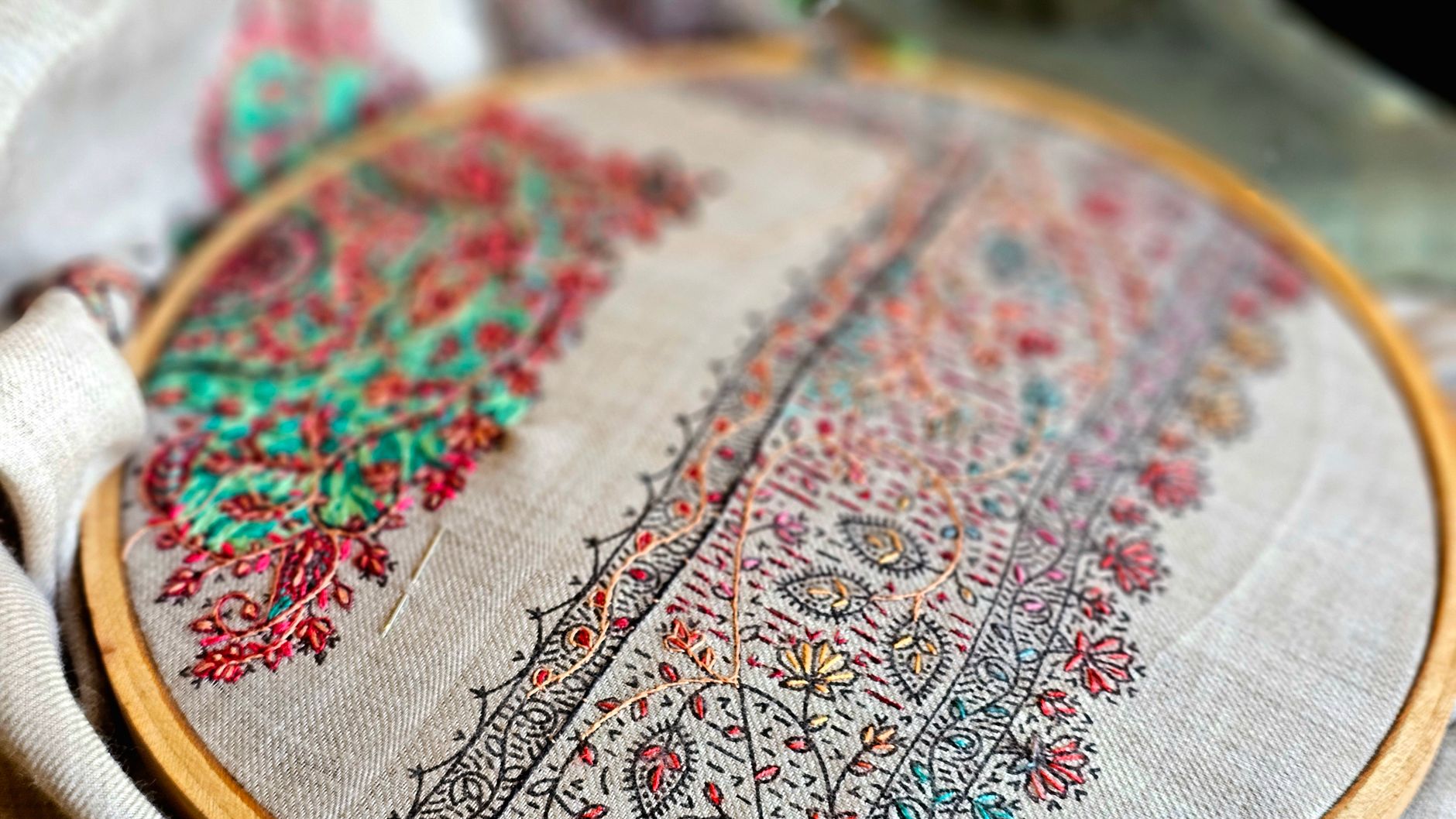
Embroidery is a craft where thread is stitched onto fabric to create patterns, pictures, words, or decorative details. It can be used to decorate clothing, bags, cushions, hoops, wall art, cards, and other fabric or craft projects.
It’s a good craft for beginners because you can start with simple stitches, a small piece of fabric, and a needle and thread. You don’t need to create complicated designs straight away.
How Does Embroidery Work?
Embroidery works by sewing decorative stitches into fabric. The stitches can be used to make lines, shapes, flowers, letters, borders, textures, or filled-in areas of colour.
Most beginner embroidery is done by hand. You place fabric in an embroidery hoop to keep it tight, thread a needle, and stitch the design onto the fabric.
Some people draw or trace a design onto the fabric first. Others use a printed pattern or stitch freely without a fixed plan.
What Can You Make With Embroidery?
Embroidery can be used for many different projects, including:
- Hoop art
- Embroidered clothing
- Tote bags
- Cushions
- Bookmarks
- Patches
- Handkerchiefs
- Table linens
- Greeting cards
- Wall hangings
- Personalised gifts
- Decorative borders
- Floral designs
- Name or initial designs
Beginners often start with small hoop designs, simple flowers, initials, or basic line drawings because these are manageable and don’t need too many stitches.
Is Embroidery Good for Beginners?
Yes, embroidery is good for beginners. You can learn one stitch at a time and build things up gradually.
A beginner doesn’t need to know lots of stitches to make something attractive. Even simple stitches like running stitch, backstitch, and satin stitch can be used to create nice designs.
The main challenge is patience. Embroidery is slower than some crafts, but that is also part of why many people find it relaxing.
What Do You Need to Start Embroidery?
To start embroidery, you need a few basic supplies:
- Embroidery hoop
- Fabric
- An embroidery needle
- Embroidery floss or thread
- Small scissors
- A pencil or fabric marker
- A simple pattern or design
You do not need a large kit at the beginning. A small hoop, some fabric, a needle, and a few colours of embroidery floss are enough to start practising.
What Is Embroidery Floss?
Embroidery floss is a type of thread commonly used for hand embroidery. It usually comes in small skeins and is made up of several strands twisted together.
Many beginners use cotton embroidery floss because it is easy to find and comes in lots of colours. You can use all the strands together for a thicker line, or separate them and use fewer strands for finer detail.
For simple beginner projects, embroidery floss is usually easier to work with than very thin sewing thread.
What Fabric Is Best for Beginner Embroidery?
Beginners usually find it easiest to start with plain woven fabric that is not too stretchy. Cotton or linen-style fabrics are common choices because they are stable and easier to stitch into.
Very stretchy, slippery, or thick fabrics can be harder to manage at first. If the fabric moves too much, your stitches may become uneven.
A simple piece of cotton fabric in an embroidery hoop is a good beginner setup.
What Is an Embroidery Hoop?
An embroidery hoop is a round frame that holds fabric tightly while you stitch. It usually has two rings: an inner ring and an outer ring. The fabric sits between them and is tightened so it stays flat.
Using a hoop makes embroidery easier because the fabric is less likely to wrinkle, shift, or bunch up while you work.
Embroidery hoops can also be used to display finished designs, especially for small pieces of hoop art.
What Are Basic Embroidery Stitches?
Some basic embroidery stitches include:
- Running stitch: a simple dashed line stitch.
- Backstitch: useful for outlines, words, and line drawings.
- Split stitch: creates a textured line.
- Stem stitch: often used for curved lines and flower stems.
- Satin stitch: fills in small shapes with smooth stitches.
- French knot: creates a small raised dot.
- Lazy daisy stitch: useful for simple petals and leaves.
- Chain stitch: creates a linked, decorative line.
Beginners do not need to learn all of these at once. Backstitch, running stitch, and satin stitch are enough for many simple projects.
Is Embroidery Expensive?
Embroidery is usually inexpensive to start. Basic supplies are affordable, and a small amount of thread can last for several projects.
It can become more expensive if you buy lots of colours, specialist fabrics, patterns, storage boxes, kits, or high-quality tools. However, you do not need everything at the very beginning.
A beginner embroidery kit can be a useful option because it often includes the hoop, fabric, thread, needle, and pattern in one place.
Is Embroidery Messy?
Embroidery is not usually messy. It does not involve paint, glue, or water, so it is a good craft for small spaces.
The main thing to manage is thread storage. Embroidery floss can tangle if it is not kept neatly. Small bags, bobbins, boxes, or thread organisers can help keep colours tidy.
Embroidery is also quite portable. You can work on a small hoop at a desk, on the sofa, or while travelling, as long as you have your supplies together.
What Is the Easiest Embroidery Project?
One of the easiest embroidery projects is a small hoop design using simple lines. For example, you could stitch a heart, flower, leaf, name, initial, or simple outline.
Other easy beginner embroidery projects include:
- A small floral hoop
- An initial on fabric
- A simple bookmark
- A stitched patch
- A line drawing
- A small tote bag decoration
- A basic border design
It’s best to start with a small design and only a few colours. Large, detailed designs can feel overwhelming when you are still learning the stitches.
Is Embroidery the Same as Cross Stitch?
Embroidery and cross stitch are related, but they are not exactly the same.
Embroidery is a broad craft that includes many types of decorative stitching. Cross stitch is one specific type of embroidery where small X-shaped stitches are usually worked on fabric with an even grid.
Cross stitch often follows a chart or pattern. Other types of embroidery can be more freeform and use many different stitches.
So cross stitch is a form of embroidery, but not all embroidery is cross stitch.
Common Beginner Embroidery Mistakes
Common beginner embroidery mistakes include:
- Pulling the thread too tightly
- Using fabric that is too stretchy
- Choosing a design that is too detailed
- Using thread that is too long
- Not separating embroidery floss when needed
- Letting thread tangle
- Making stitches uneven
- Rushing the design
A useful beginner tip is to use shorter lengths of thread; very long thread may seem convenient, but it tangles more easily.
Who Might Enjoy Embroidery?
Embroidery may suit you if you enjoy slow, detailed, relaxing crafts. It is especially good if you like fabric, colour, hand stitching, personalising items, or making handmade gifts.
It may also be a good hobby if you want something:
- Affordable to start
- Low mess
- Suitable for small spaces
- Portable
- Relaxing and repetitive
- Easy to personalise
- Possible to do in short sessions
However, embroidery may not be ideal if you dislike slow progress or fiddly work. Starting with a small, simple pattern can make it much easier.
Final Thoughts
Embroidery is a beginner-friendly craft where thread is stitched onto fabric to create decorative designs. It can be used for hoop art, clothing, gifts, home decor, and many other creative projects.
If you are new to embroidery, start with a small hoop, plain fabric, embroidery floss, and a simple pattern. Learn a few basic stitches first, such as running stitch, backstitch, and satin stitch. Once you understand the basics, you can gradually try more detailed designs and different types of stitches.
Leave a Reply