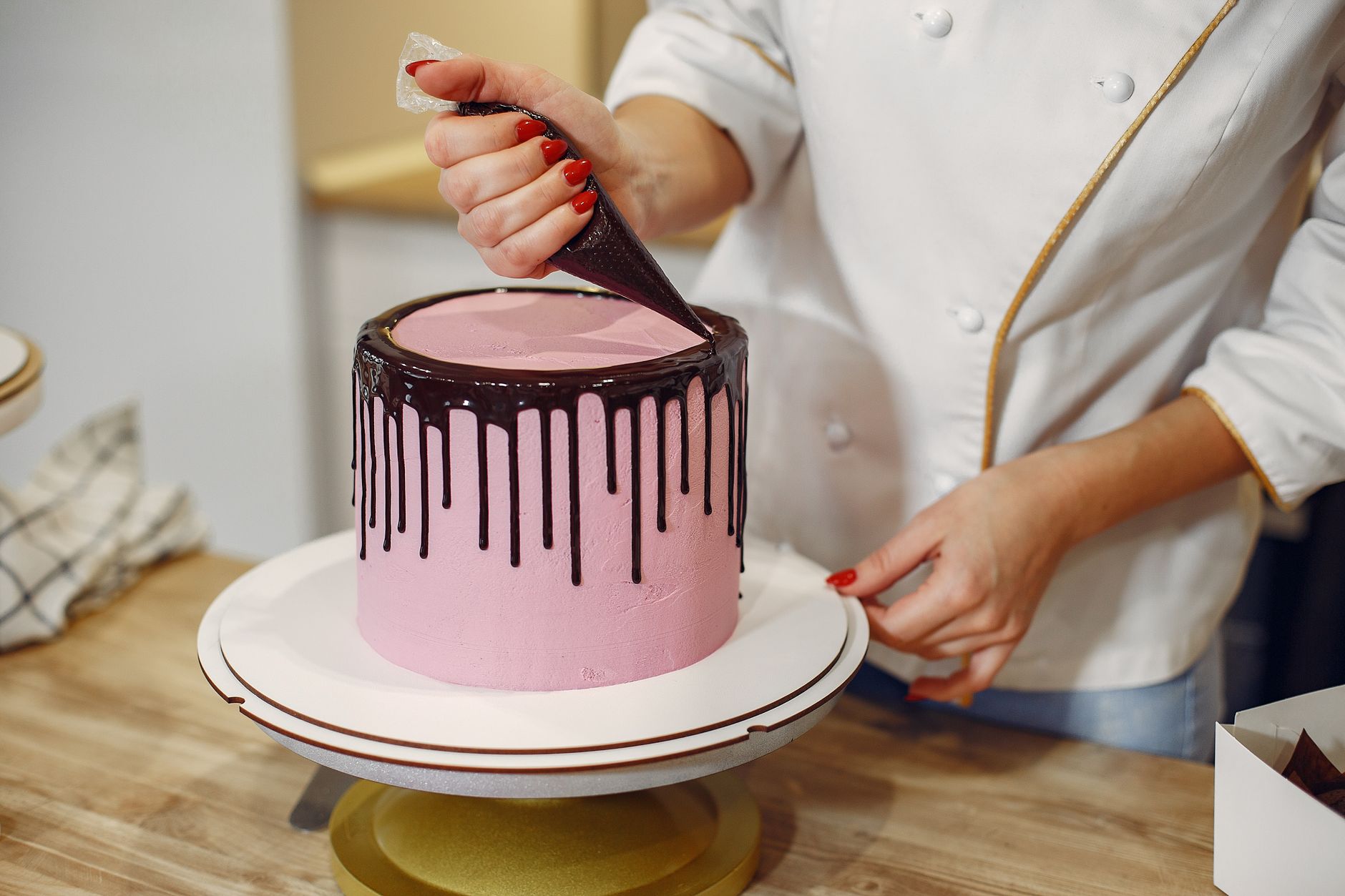
Cake decorating is the process of adding icing, frosting, decorations and other finishing touches to a baked cake to make it look more enticing.
Decorating cakes be as simple as spreading buttercream over a sponge cake or as detailed as creating flowers, patterns and figures out of icing.
Some people decorate cakes as part of baking, while others treat cake decorating as a separate creative hobby. You don’t have to be an expert baker to enjoy it, as you can practise by decorating homemade cakes, simple cupcakes or even ready-made cakes.
What Do People Do in Cake Decorating?
Cake decorating involves changing the appearance of a cake after it has already been baked and cooled.
This might include:
- Covering a cake with buttercream
- Piping borders and patterns
- Adding sprinkles or edible decorations
- Covering cakes with fondant icing
- Making icing flowers
- Writing messages on cakes
- Creating themed birthday cakes
- Decorating cupcakes and biscuits/ cookies
The amount of decorating involved depends on the project. A beginner might start by adding a simple buttercream swirl to a cupcake, while a more experienced decorator might create a impressive multi-tiered celebration cake.
Is Cake Decorating the Same as Baking?
Whilst cake decorating and baking are related, but they are not quite the same skill.
Baking involves preparing and cooking the cake itself, while cake decorating begins after the cake has been baked, cooled and prepared.
A person can be a good baker without doing much decoration. Likewise, someone interested mainly in decorating can practise using simple sponge cakes, cupcakes or cakes bought from a shop.
However, understanding a few basic baking principles can make decorating easier. For instance, a cake needs to be strong enough to support the icing and decorations placed on it.
How Does Cake Decorating Work?
The cake is normally allowed to cool completely before it is decorated. Decorating a warm cake can cause buttercream or frosting to melt.
The surface may then be levelled so that the top of the cake is flat. Layers can be filled with buttercream, jam, ganache or another filling.
A thin layer of icing called a ‘crumb coat’ is sometimes added first. This helps trap loose cake crumbs and creates a smoother surface for the final layer.
The decorator can then add the main covering and any finishing details. These might include piped icing, edible decorations, fondant shapes or a written message.
Is Cake Decorating Good for Beginners?
Cake decorating can be a good hobby for beginners because it is easy to start off with small, simple projects.
You don’t need to begin with large celebration cakes or complicated fondant models. Cupcakes, traybakes and small sponge cakes are often easier starting points.
Beginner-friendly techniques include:
- Spreading buttercream with a palette knife
- Piping simple swirls
- Adding sprinkles
- Using ready-made decorations
- Making basic icing shapes
- Creating drip-style cakes
- Decorating biscuits with icing
Your first attempts may not look perfectly neat, but they can still be enjoyable (and edible!). Your control and consistency generally improve with practice.
What Do You Need to Start Cake Decorating?
You can begin cake decorating with a small collection of basic tools.
Useful beginner supplies include:
- A cake or cupcakes to decorate
- Buttercream, frosting or icing
- A mixing bowl
- A spatula or palette knife
- Piping bags
- One or two piping nozzles
- Food colouring
- Sprinkles or simple decorations
A cake turntable can make it easier to cover and decorate the sides of a cake, but it’s not absolutely essential for your first project.
Keep in mind also that you do not need a large collection of piping tips. A basic round nozzle and a star-shaped nozzle can be used for many beginner designs.
What Types of Icing Are Used for Cake Decorating?
Different types of icing create different finishes.
Buttercream
Buttercream is soft, spreadable and commonly used for covering cakes and piping decorations. It is often one of the easiest options for beginners.
Fondant
Fondant is a smooth, rollable icing that can be placed over a cake. It creates a neat finish and can also be shaped into decorations.
It can take some practice to roll and apply fondant smoothly.
Royal Icing
Royal icing is made of sugar, egg whites, and lemon juice. It dries hard and is often used for detailed piping, writing and decorating biscuits. It can also be used to make small decorations in advance.
Ganache
Ganache is usually made from chocolate and cream. It can be used as a filling, cake covering or drip decoration.
Glaze
A glaze is a thinner icing that can be poured or drizzled over cakes, buns and biscuits.
What Can You Decorate?
Cake decorating is not limited to large cakes.
You can decorate:
- Cupcakes
- Sponge cakes
- Layer cakes
- Traybakes
- Biscuits/ cookies
- Doughnuts
- Cake pops
- Muffins
- Celebration cakes
Cupcakes are particularly useful for practising because each one provides a separate surface. You can test several piping styles without committing to decorating (or ruining) an entire cake.
What Are Some Popular Cake Decorating Techniques?
There are many different techniques that you can explore as your confidence grows.
Piping
Piping involves placing icing in a piping bag and pushing it through a shaped nozzle. It can be used to create swirls, borders, flowers, lines and written messages.
Smooth Buttercream
Buttercream can be spread over the cake and smoothed using a palette knife or cake scraper.
Fondant Modelling
Fondant can be rolled, cut and shaped into figures, flowers and themed decorations.
Drip Decoration
A drip cake has ganache or icing running partially down the sides. This creates a decorative finish without needing extremely precise piping. See the image at the top of this article for an example.
Textured Icing
Instead of making the icing completely smooth, you can create deliberate swirls, ridges and patterns using a spoon or palette knife.
Stencilling
Cake stencils can be used to add repeated patterns using icing, food colouring or edible powder.
Does Cake Decorating Require Much Space?
Basic cake decorating doesn’t need a large kitchen or work space to be done.
You mainly need:
- A clear work surface
- Space for the cake
- Room for your tools and ingredients
- Somewhere cool to store the finished cake
However, the hobby can gradually require more storage as you collect equipment such as piping nozzles, cutters, moulds, colouring gels and decorating tools.
Unlike many other crafts, it makes sense to store your equipment for cake making in the kitchen. Keeping supplies in labelled boxes or drawers can help prevent small tools from becoming difficult to find.
Is Cake Decorating Expensive?
Cake decorating can be started relatively cheaply, particularly if you already own basic baking equipment.
The cost can increase, however, should you choose to buy:
- Professional cake turntables
- Lots of different nozzles
- Specialist moulds and cutters
- Airbrushing equipment
- Edible printing equipment
- Premium ingredients
- Cake stands and transport boxes
The most sensible approach is to start with a few versatile tools and buy additional equipment only when a project requires it.
What Is a Good First Cake Decorating Project?
Decorating cupcakes with buttercream is one of the easiest ways to begin.
You can make or buy a small batch of plain cupcakes and practise:
- Filling a piping bag with buttercream
- Holding the bag steadily
- Applying even pressure
- Piping a swirl from the outside towards the centre
- Adding a few sprinkles
Another easy option is to cover a small sponge cake with buttercream and create a textured finish using the back of a spoon.
These projects let you practise without needing perfectly smooth icing or advanced equipment.
Is Cake Decorating a Practical Hobby?
Cake decorating produces something that can be eaten, shared or made for a particular occasion; how much more practical can you get!
People often decorate cakes for:
- Birthdays
- Weddings
- Anniversaries
- Holidays
- Baby showers
- Parties
- Seasonal or faith events
It can also become a useful skill for making personalised gifts or reducing the cost of buying professionally decorated cakes.
As you become better at decorating cakes, you can motivate yourself to improve even further by attempting to make something special for a loved one’s birthday or other occasion.
Some decorators eventually sell cakes, but selling food usually involves additional hygiene, labelling and business requirements. It is best to learn the practical skills first and get good before trying to turn it into a business.
What Hobbies Are Similar to Cake Decorating?
Cake decorating may appeal to people who enjoy:
- Baking
- Biscuit (cookie) decorating
- Sugarcraft
- Food photography
- Party planning
- Paper crafts
Like many crafts, cake decorating combines planning, colour, texture and hand control. The difference is that the finished project is edible!
Can You Learn Cake Decorating at Home?
Many basic cake decorating techniques can be practised at home.
It helps to focus on one technique at a time rather than attempting an elaborate cake immediately.
For example, you could practise:
- Smoothing buttercream one week
- Piping swirls the next
- Writing with icing
- Making simple flowers
- Covering a small cake with fondant
Repeated practice is often more useful for transforming your skills than buying large amounts of fancy equipment.
Is Cake Decorating Worth Trying?
Cake decorating can be a rewarding hobby for anyone who enjoys creative projects, baking or making things for other people.
It is accessible enough for beginners but offers plenty of room to develop more advanced skills. You can start with a piping bag and a few cupcakes, then gradually explore celebration cakes, fondant modelling and detailed designs.
Your first cake does not need to look professional. You’re aiming to learn how the materials behave, practise controlling the icing and create something you enjoy making.