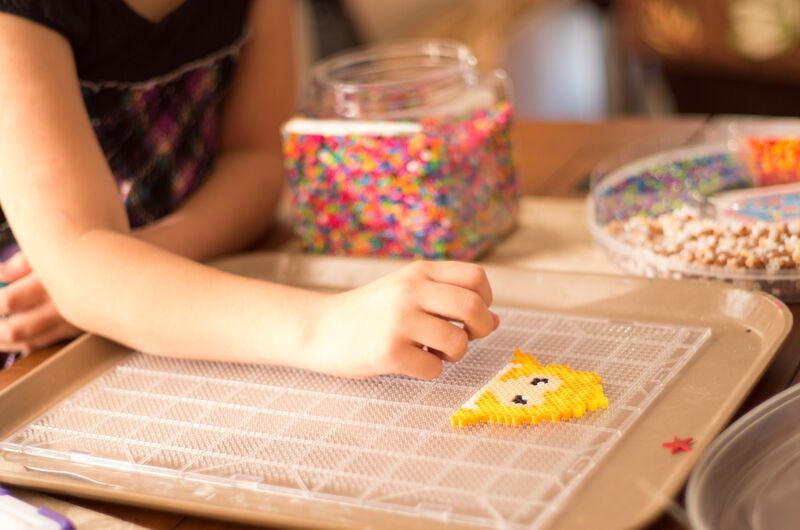
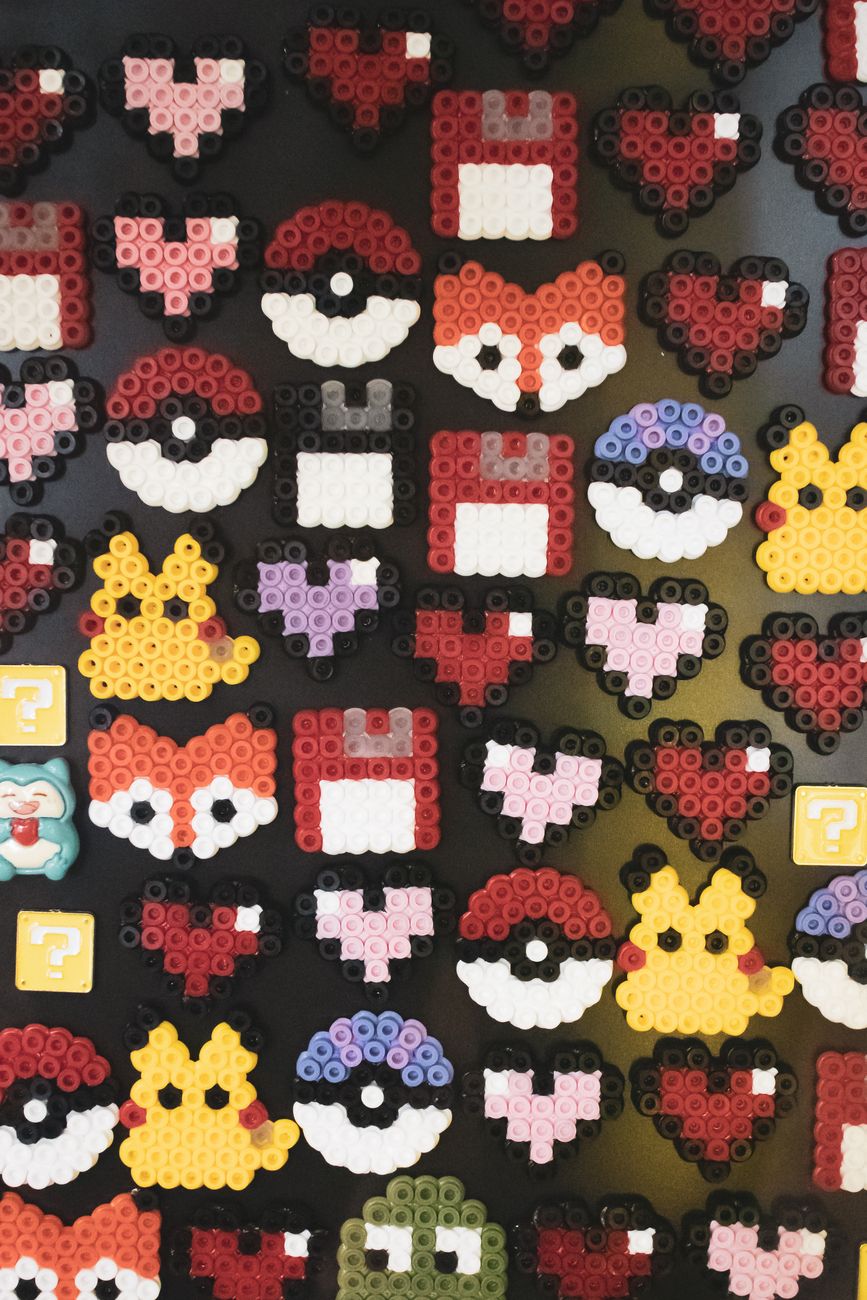
Hama beads are small plastic beads that you arrange on a pegboard to create pictures, patterns and decorations.
Once the design is finished, the beads are usually covered with ironing paper and gently heated with an iron. The heat causes the beads to soften and fuse together, allowing the finished design to then be removed from the board.
Hama is a particular brand of fuse bead, leading the market in Europe. Although it’s a brand, it is sometimes used as a generic term in countries such as the UK.
Similar products are often called fuse beads or ironing beads. Perler is another similar brand that is more widespread in the North America.
How Do Hama Beads Work?
Each Hama bead has a hole through the centre and fits over one of the small pegs on a reusable pegboard.
You place the beads onto the board one at a time to build a design. A simple picture may only use a few colours, while a larger piece can contain hundreds or even thousands of beads.
When the pattern is complete, ironing paper is placed over the top. An iron is then moved gently across the design so that the exposed surface of the beads begins to melt.
As the beads soften, they join to the beads beside them. The design is then left to cool before being carefully removed from the pegboard.
Some people also iron the second side to make the finished piece stronger.
Are Hama Beads Good for Beginners?
Hama beads are a good craft for beginners because the basic process is quite easy and simple to follow. It’s not a particular technique that you need to get used to, like a potter’s wheel.
You don’t need to be able to draw or paint very well, either. The pegboard creates a grid, so you can build a design by following a pattern one bead at a time.
Beginners can start with a small shape, such as:
- A heart
- A flower
- A star
- A simple animal
- A piece of fruit
- A letter or initial
Mistakes are usually easy to correct before the design is ironed. You can just pick up a bead and replace it with a different colour.
However, the ironing stage needs to be completed carefully. Children should have adults do the ironing part of the process for them, as the iron and softened plastic get very hot.
What Do You Need to Start Using Hama Beads?
You only need a few basic supplies to begin.
Hama Beads
The beads are available in many different colours. You can buy mixed tubs, individual colour packs or themed sets.
A mixed collection is useful for experimenting, while separate colour packs may be better when you want to follow a particular pattern.
A Pegboard
The pegboard holds the beads in position while you build the design.
Boards are available in different shapes, including squares, circles, hearts and animals. Square boards are particularly versatile because they can be used for pixel-style pictures and geometric patterns.
Some square boards can be connected together to create larger designs.
Ironing Paper
Ironing paper is placed between the beads and the iron.
It prevents the plastic from sticking to the iron and helps distribute the heat across the design. Baking parchment may sometimes be used as an alternative, but it should be suitable for heat and should not have a wax coating.
An Iron
A household iron is used to fuse the beads.
The temperature and ironing time can vary, so it is sensible to follow the instructions provided with the beads. Too little heat may leave the design weak, while too much heat can flatten the beads or damage the pegboard.
Optional Tweezers
Tweezers are not essential, but they can make it easier to place and remove individual beads.
They are especially useful when working with small beads or detailed patterns.
What Sizes of Hama Beads Are Available?
Hama beads are available in several sizes.
Maxi Beads
Maxi beads are the largest option. They are easier to pick up and may be suitable for younger children or very simple designs.
Midi Beads
Midi beads are the standard and most commonly used size.
They are large enough to handle fairly easily but small enough to create detailed pictures. Most beginner kits and online patterns are designed for Midi beads.
Mini Beads
Mini beads are much smaller and can be used for detailed designs.
However, they are more difficult to handle and require a matching Mini pegboard. They may be better suited to older children or adults who already have experience with fuse beads.
Beads and boards of different sizes are not normally interchangeable.
What Can You Make With Hama Beads?
Hama beads can be used to create both decorative and practical items.
Possible projects include:
- Coasters
- Keyrings
- Magnets
- Decorations
- Bookmarks
- Jewellery
- Name signs
- Christmas ornaments
- Characters and animals
- Small three-dimensional models
A flat design can sometimes be turned into another item by adding a magnet, keyring attachment, ribbon or jewellery finding.
Several separate pieces can also be joined together to make boxes, pencil holders or small models.
Do You Have to Iron Hama Beads?
You normally do need to iron Hama beads if you want to remove the design from the pegboard and keep it as one complete piece.
Without ironing, the individual beads remain loose; they then fall off the board if it is moved or knocked.
However, fuse beads can also be used in other ways. Some people thread them onto cord, use them in jewellery or add them to other craft projects without melting them.
Do You Iron Both Sides of Hama Beads?
You don’t have to iron both sides.
Ironing both sides usually creates a stronger finished piece, which may be useful for keyrings, coasters or items that will be handled frequently.
The design should be allowed to cool slightly before it is turned over. It can then be covered with ironing paper and gently ironed on the second side.
Avoid using excessive heat, as this can cause the beads to become overly flat or distorted.
Can You Reuse Hama Bead Pegboards?
Yes, Hama bead pegboards are designed to be reusable.
Once the fused design has cooled and been removed, you can use the board for another project.
However, a pegboard may warp if it becomes too hot during ironing, so keep the iron moving and avoid pressing down heavily.
Some crafters remove the completed design from the pegboard before fully fusing it, but this is a more advanced method because the loose beads can easily move out of place.
Are Hama Beads the Same as Perler Beads?
Hama and Perler are different brands of fuse beads.
They work in a similar way; the beads are arranged on a pegboard and fused using heat. Availability may depend on where you live, with Hama beads being especially familiar in the UK and Europe.
Although beads from different brands can sometimes be used together, they may melt at slightly different rates. This can create an uneven finish, so using one brand within a design should produce more consistent results.
How Much Space Do Hama Beads Need?
Hama beads don’t require a large permanent craft area.
A small table or desk is usually enough for a beginner project. The beads, boards and patterns can be stored in a drawer, box or divided organiser when they are not being used.
Because the beads are small and easy to spill, containers with secure lids are useful. Sorting beads by colour can also make patterns quicker to complete.
Are Hama Beads Expensive?
Hama beads can be a relatively affordable craft to begin.
A starter set may include beads, a pegboard, ironing paper and several patterns. This provides almost everything needed for a first project.
The cost can increase if you buy many separate colours, large boards or specialist accessories. However, pegboards can be reused, and leftover beads can be saved for future designs.
Final Thoughts
Hama beads are small plastic fuse beads used to create pictures, patterns and decorations on a pegboard.
They are a beginner-friendly craft because designs can be built one bead at a time, and mistakes are easy to change before ironing. You only need beads, a suitable pegboard, ironing paper and access to an iron to get started.
Small designs are a manageable first project and can help you practise placing the beads and applying an even amount of heat before moving on to larger patterns.