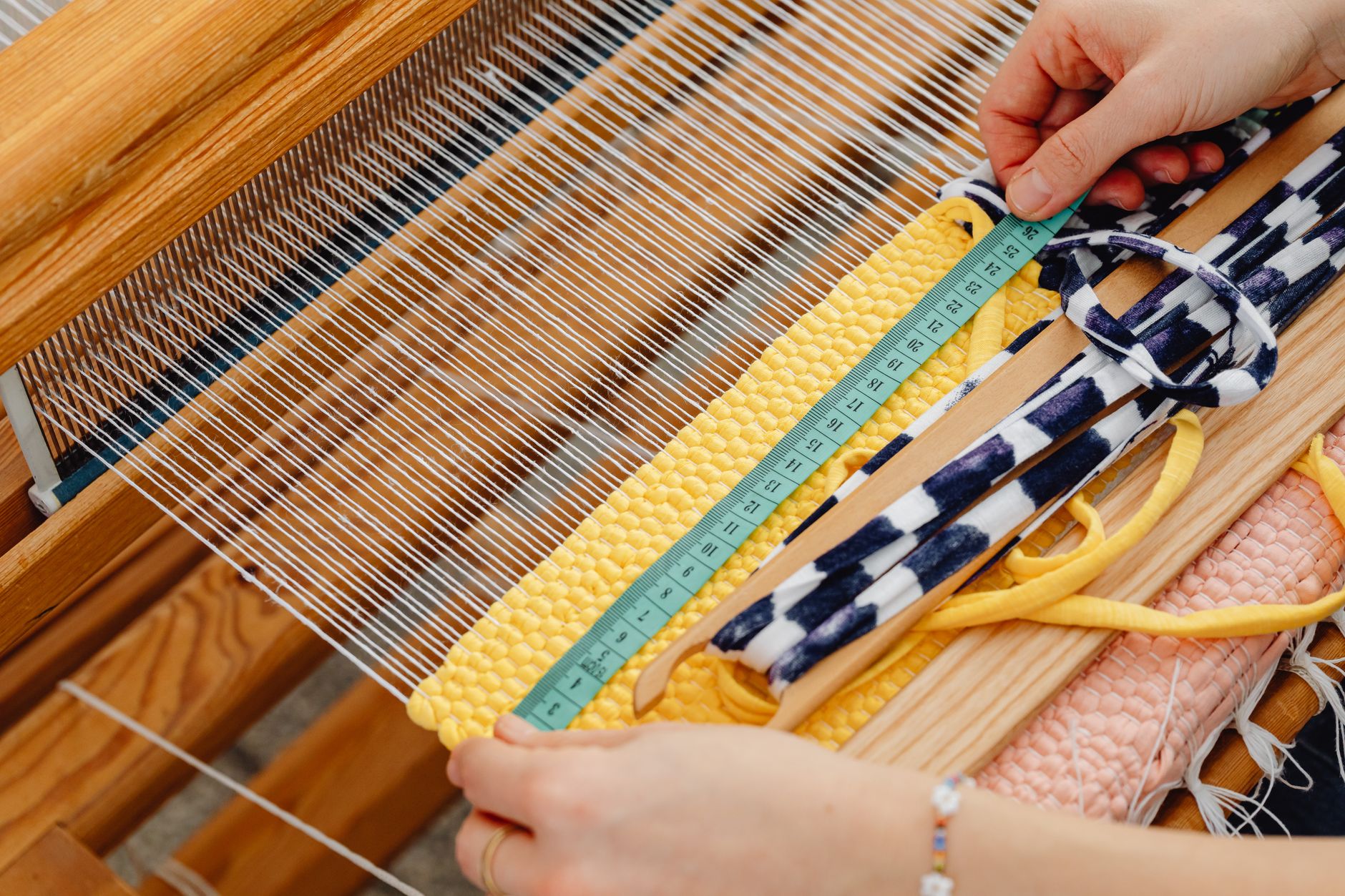
Weaving is a craft technique where two sets of threads or fibres are interlaced to make fabric, cloth, wall hangings, baskets, rugs and decorative pieces. It’s one of the very oldest textile crafts, but it can also be a simple beginner hobby using yarn, wool, string, paper, fabric strips or natural materials.
The basic idea of weaving is fairly simple; one set of threads stays in place, and another thread passes over and under them to create a pattern.
What Does Weaving Mean?
Weaving means creating a material by crossing threads or fibres together. The threads that run up and down are called the warp, and the thread that goes across is called the weft.
The warp is usually held under tension on a loom, frame or simple cardboard base. The weft is then passed over and under the warp threads to build up the woven fabric.
You can weave neatly and evenly, or you can use thicker yarns, textures and colours to make something more decorative and freeform.
How Does Weaving Work?
Weaving works by interlacing fibres in a repeated pattern. The simplest pattern is plain weave, where the weft thread goes over one warp thread, then under the next, and repeats across the row.
On the next row, the pattern usually alternates so the threads lock together. As more rows are added, the woven material becomes stronger and more solid.
A beginner weaving project might be made on a small frame loom, cardboard loom or even a piece of stiff card with notches cut into it.
What Do You Need for Weaving?
You don’t need many supplies to try basic weaving. For a simple beginner project, you may need:
- Yarn, wool, string or thread
- A small loom, frame or piece of cardboard
- Scissors
- A needle, shuttle or your fingers
- A comb or fork to push the rows down
- A dowel, stick or rod if making a wall hanging
If you enjoy weaving, you can later add more specialist tools such as a tapestry needle, weaving shuttle, heddle bar, rigid heddle loom or larger frame loom.
What Is a Loom?
A loom is a tool that holds the warp threads in place while you weave. Looms can be very simple or a lot more complex.
Beginner looms include cardboard looms, peg looms and small frame looms. These are good for learning because they are inexpensive and easy to understand.
More advanced looms, such as rigid heddle looms and floor looms, make it easier to weave larger pieces of fabric more evenly and quickly.
What Can You Make With Weaving?
Weaving can be used to make both practical and decorative items. Beginner weaving projects include:
- Small wall hangings
- Coasters
- Placemats
- Bookmarks
- Mini rugs
- Woven bracelets
- Simple fabric samples
- Decorative panels
- Woven baskets
Tapestry weaving is often used for decorative wall art, while other types of weaving can be used to make cloth, scarves, rugs and household textiles.
Is Weaving Easy for Beginners?
Weaving is fairly easy to start because the basic over-and-under motion is simple. The challenge is keeping the tension even and making sure the edges do not pull in too tightly.
For beginners, it is best to start with a small project. A tiny wall hanging, coaster or cardboard loom sample is much easier than trying to make a large piece of fabric straight away.
Weaving is also quite forgiving. If a row looks uneven, you can usually loosen it, adjust the yarn or undo a small section.
Is Weaving the Same as Knitting or Crochet?
Weaving is not the same thing as knitting or crochet. All three crafts use yarn or thread, but they create fabric in different ways.
Knitting uses loops made with knitting needles. Crochet uses one hook to make loops and stitches. Weaving uses warp and weft threads crossed together at right angles.
Weaving often creates a flatter, more structured fabric, while knitting and crochet usually create stretchier fabrics.
What Is Tapestry Weaving?
Tapestry weaving is a type of weaving used to create pictures, patterns or decorative wall hangings. It is usually done on a frame loom using different colours and textures of yarn.
Unlike weaving fabric for clothing, tapestry weaving does not always need to be perfectly even or flexible. It can be more artistic and textured, which makes it a popular choice for beginners who want to make decorative pieces.
Tapestry weaving is a good starting point if you enjoy colour, texture and slow, hands-on crafts.
What Is Basket Weaving?
Basket weaving is a related craft where flexible materials are woven together to make baskets, trays and containers. Instead of soft yarn, basket weaving often uses materials such as willow, cane, reed, raffia, paper strips or rope.
Basket weaving is usually more structural than yarn weaving. It can be simple, but some materials are harder to bend and may need soaking or preparation before use.
Why Do People Like Weaving?
People enjoy weaving as it’s repetitive, calming and creative. The basic movement is easy to understand, but there is still plenty of room to experiment with colour, texture and pattern.
Weaving can also be a good craft for using leftover yarn, fabric strips or natural materials. Small weaving projects do not need much space and can be done slowly over time.
It is a craft that can stay simple or become more advanced depending on your interest.
Final Thoughts
Weaving is the process of interlacing threads, yarns or fibres to create fabric, art or useful objects. It usually involves warp threads held in place and a weft thread passed over and under them.
For beginners, weaving is easiest to learn with a small frame loom or cardboard loom. A simple wall hanging, coaster or sample piece can teach the basic technique without needing many supplies.
Once you understand the basic over-and-under structure, weaving can lead into tapestry weaving, fabric weaving, basket weaving, rugs, wall art and many other creative projects.